European German Bavarian Art Sculpture Gifts Crafts Store Shop
| Bayerisches Nationalmuseum | |
 Bavarian National Museum | |
| Location within Bavaria | |
| Established | 1855 |
|---|---|
| Type | Art museum |
| Founder | Maximilian II of Bavaria |
| Website | world wide web |


Bavarian National Museum, Munich

The Bavarian National Museum (German: Bayerisches Nationalmuseum ) in Munich is ane of the nearly important museums of decorative arts in Europe and one of the largest art museums in Deutschland.[ citation needed ] Since the starting time the collection has been divided into two principal groups: the art historical collection and the sociology drove.
History and building [edit]
The museum was founded by King Maximilian Two of Bavaria in 1855. It houses a large collection of European artifacts from the late artifact until the early 20th century with particular strengths in the medieval through early modern periods.

Narcissus fountain in the courtyard
The building, erected in the style of historicism by Gabriel von Seidl 1894-1900, is 1 of the most original and significant museum buildings of its time. Information technology is situated in the Prinzregentenstraße, ane of the city's iv royal avenues. The house replaced an older edifice which houses today the Museum Five Continents. Already in 1905/06, the museum was expanded to the north by a few rooms and a workshop wing. German Bestelmeyer added a wing at the southeast corner in 1937.
The main edifice of the Bavarian National Museum includes on three floors exhibition rooms with in full about 13,000 foursquare meters. The core of the collection dates from the art collection of the Wittelsbach family. This gives the National Museum an importance far beyond the local area. Diversity and breadth of the collections, withal, were particularly motivated past the new additions to the subsequent period. To date, the inventory is updated continuously non only through acquisitions, merely too by significant foundations and bequests. Back up experienced past the National Museum, in detail, past the 1960 launched club "Friends of the Bavarian National Museum".
The National Museum has several branch museums throughout Bavaria. A new building behind the museum houses as add-on the Bavarian State Archaeological Collection (Archäologische Staatssammlung) from the start settlement in the Paleolithic Ages through the Celtic culture and the Roman catamenia right up to the early Middle Ages.
Decorative arts [edit]


The art collection displays artworks in a bout through more than 40 rooms from the hall for late antiquity and Romanesque art via the rooms for Gothic, Renaissance, Bizarre and Rococo art to the exhibits of Neoclassicism and Art Nouveau. The western side wing of the museum houses The Bollert Collection with late medieval sculptures.
The museum is peculiarly noted for its collections of carved ivory, goldsmith works, textiles, glass painting, tapestries and shrines. The displayed sculptures were created past noted sculptors including Erasmus Grasser, Tilman Riemenschneider, Hans Multscher, Hans Leinberger, Adam Krafft, Giovanni Bologna, Hubert Gerhard, Adriaen de Vries, Massimiliano Soldani Benzi, Johann Baptist Straub, Ferdinand Tietz, Ignaz Günther, Matthias Steinl, and Ludwig Schwanthaler. The museum is famous for its collections of courtly culture, musical instruments, piece of furniture, oil paintings, sketches, clocks, stoneware, majolica, miniatures, porcelain and faience, and its statues. It has probably the world's best collection of the Nymphenburg porcelain figures of Franz Anton Bustelli (1723–63).

The Romanesque period is represented by stone sculptures from the monastery of Wessobrunn and the marble lions from Reichenhall. Of import pieces of Romanesque art include wooden figures of crucifixion groups from Bamberg, Schongau and Kaufbeuren, and several works of metallic and ivory. The Kasten der Heiligen Kunigunde (jewelry box of Holy Cunegonde), is a unique masterpiece made in the year chiliad in Scandinavia of woods, bronze and narwhal tusk. Reliefs from the Magdeburg Ivories, plaques probably from an antependium of Emperor Otto I and a relief of the Due west Roman imperial courtroom with one of the oldest representations of the Ascension amid the nigh famous works in the ivory drove. Primal works of ivory art, important stained glass windows, and not least splendid testimonies of textile are found in the Gothic department. On display are likewise historic Gothic bedchamber ensembles such as the magnificently painted Zunftstube of Augsburg weavers, one of the finest Gothic cabinets at all. The Bavarian National Museum displays one of the largest and most important collections of late medieval sculpture from the High german-speaking countries. Special attractions are the great knight'due south hall with the ceremonial armor of the 15th and 16th Century and the true to scale wooden Renaissance models of the Bavarian ducal capitals.
The portrait fine art of the Renaissance is represented past medals, miniatures, paintings and total plastic sculptures. Many items come from the fine art bedroom of the Wittelsbach family. From the possession of the Wittelsbach the Bavarian National Museum also presents unique Bizarre objects from all areas of craft and creative production, such equally ostentatious piece of furniture, jewelry, weapons, musical instruments, watches, glasses, miniatures, ivories and bronzes. Of importance are especially Florentine bronzes from the collection of the Medici and pastel paintings from Venice including works of Rosalba Carriera. The Bavarian National Museum has the near of import collection of the Bavarian Rococo sculpture. A rich collection of architectural models and designs for frescoes and altarpieces documents the new buildings and conversions of churches in the competition of the diverse monasteries and convents. A unique court ensembles are the silverware of the Prince-Bishop of Hildesheim and the service and figurative centrepieces of Nymphenburg and Meissen porcelain manufacturers. Rare furnitures testify to the high rank of the most famous German language cabinetmaker manufactories of the 18th Century.
The collection of Neo-classical art of the 19th Century is likewise strongly influenced by works that once belonged to the Wittelsbach family. Thus, from the estate of Maximilian's begetter King Ludwig I are magnificent presents of Napoleon Bonaparte which arrived at the Museum, a result of the strong connection between France and Bavaria. Of special importance is for example a splendid table with precious wood with a rich porcelain decor, a gift Napoleon gave in 1806 to the Crown Prince Ludwig. The Art Nouveau Section shows, for case, the floral art direction, an expression of Art Nouveau inspired by the plants and animals, first adult in French republic. The drove of fine glass and porcelain and ceramics includes many objects of high artistic and technical quality of the most of import centers of this epoch in Europe and the Us. The museum displays a major drove of Fine art Nouveau objects, including the work of Louis Comfort Tiffany, René Lalique, Émile Gallé and several Bavarian artists.
Menstruum rooms [edit]
Many of the museum's treasures are displayed in antique rooms moved to the museum. For instance, the armor is in one of several rooms featuring gothic ribbed vaulting form medieval buildings, magnificent renaissance furnishings are displayed in rooms roofed with decorative woods-beamed and mullioned ceilings grade the 14th and 15th centuries, and the bizarre objects in rooms with 16th century wood paneling and decorative ceilings.
Folklore collection [edit]
The folklore collection houses for example traditional Bavarian furnitures, rural pottery, crockery and religious folklore including an outstanding collection of Neapolitan, Sicilian, Tyrolian and Bavarian forest carvings including street scenes and Nativity Scenes.
Nativity scenes [edit]
The museum holds an all-encompassing collection of Birth scene from the fifteenth through early nineteenth centuries, dramatically and imaginatively displayed. Many of the scenes display wonderful craftsmanship and detailed workmanship, some are worked in precious materials, others show exotic elements, similar a Flying into Arab republic of egypt intended to amaze 18th century viewers with the monkeys, crocodiles and hippopotamuses Mary and Joseph encounter on the Nile.
Gallery [edit]
-
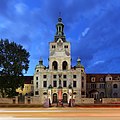
Main building at nighttime
-

-

Tilman Riemenschneider: Saint Sebastian
-
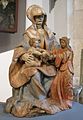
Hans Leinberger St. Anna Selbdritt
-

Niclaus Gerhaerts von Leyden: Jesus with grapes
-

External links [edit]
- Bavarian National Museum
- Bavarian Land Archaeological Collection
Coordinates: 48°08′35″Northward xi°35′28″East / 48.14306°N xi.59111°E / 48.14306; 11.59111
Source: https://en.wikipedia.org/wiki/Bavarian_National_Museum
0 Response to "European German Bavarian Art Sculpture Gifts Crafts Store Shop"
Post a Comment