Did Asepsis Have a Profound Effect on the Healing Arts During the Renaissance
The history of wound intendance spans from prehistory to modern medicine. Wounds naturally heal past themselves, but hunter-gatherers would have noticed several factors and sure herbal remedies would speed up or assist the process, especially if it was grievous. In aboriginal history, this was followed by the realisation of the necessity of hygiene and the halting of bleeding, where wound dressing techniques and surgery developed. Eventually the germ theory of disease too assisted in improving wound care.
Ancient medical practice [edit]

A drinking glass container containing tubocurarine chloride. Tubocurarine was used in aboriginal times every bit a poison, but was used in the 20th century equally a muscle relaxant.
Over time, different civilizations began to create their ain herbal medicinal treatments for wounds depending on the copse, shrubs, or any other type of plants located in their environment. These herbal treatments became the oldest form of wound therapy. It is logically assumed that this may not have been a very safe mode of treating humans with wounds due to overdosing or choosing the wrong plants to treat a person until the right one was institute. Nevertheless, virtually of the aboriginal people who were given the duty of healers through the usage of herbs were well accepted with which plants from their local flora could be used to assistance the injured. This noesis was learned and passed downwards after healers repeatedly used an herbal remedy for a specific wound with the conventionalities that it promoted healing.[i]
Numerous aboriginal herbal remedies and poisons now serve as models for modern medicine. For example, curare, which was an ancient South American arrow toxicant, was used in the 20th century as the musculus relaxant tubocurarine.[ii] Tribesmen conducted diverse observations on the effects of different plant parts, meaning roots, leaves, etc., on specific wounds. They likewise observed what seasons, time of day, or moon phase would result in a about agile institute. The former however resulted in a minimal influence in mod medicine as compared to plants parts or seasons of growth.[1]
Ancient Greece [edit]
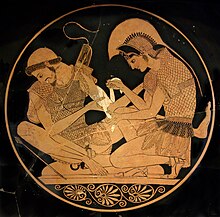
As tribal healers developed into doctors, it spurred on a primitive pharmaceutical manufacture that included traders who would travel overseas bringing herbs that would exist used for specific wounds. Soon, like near industries, patients began to skip the doctors altogether and purchased the herbs directly from the traders who were also aware of the effects and quantities that should be taken while besides informing their "patients" of them. These merchants that supplied people with herbs were known every bit rhizotomiki, or gatherers of roots, in Ancient Greece. The earliest known listing of herbs and remedies was probably written for these herbal merchants. The earliest known to men is the Rhizotomika of Diocles of Carustius, a student of Greek philosopher Aristotle. This book includes the author's observation of the effects of the herbal medicine on specific parts of the human body. This then became the beginning of scientific inquiry on herbal remedies on humans, which has been modified and significantly inverse from modern wound remedies.[one]
The Greeks also acknowledged the importance of wound closure, and were the first to differentiate betwixt acute and chronic wounds, calling them "fresh" and "non-healing", respectively. Galen of Pergamum, a Greek surgeon who served Roman gladiators circa 120–201 A.D., made many contributions to the field of wound care.[three] The near of import was the acknowledgment of the importance of maintaining wound-site moisture to ensure successful closure of the wound.[4]
Ancient Egypt [edit]
The clinical history of the handling of acute and chronic wounds can too trace its origins to aboriginal Egypt, and many Egyptian medical papyri take survived which document herbal, surgical and magical remedies for wounds. The Edwin Smith Papyrus, c. 1600 BCE, describes closing wounds with sutures (for wounds of the lip, throat, and shoulder),[five] bandaging, splints, poultices,[6] preventing and curing infection with beloved, and stopping bleeding with raw meat.[7] : 72 The Ebers Papyrus, c. 1500 BCE, details the use of lint, animate being grease, and honey as topical treatments for wounds. The lint provided its natural absorbency, the brute grease provided a barrier to environmental pathogens, and the honey served as an antibiotic amanuensis.[viii] The Brugsch Papyrus, c. 1200 BCE, stated that the Egyptians believed that making sure a person'due south wound stayed closed would help their own spirit not exist invaded by external evil spirits.[ix] [x]
Remedies used in ancient treatments [edit]
Love [edit]
Honey was utilized for its antibacterial backdrop that helped heal infected wounds.[11] Moreover, honey was used equally a topical ointment. Other than sugar, dear likewise contains a variety of trace amounts of many dissimilar vitamins and proteins.
Alcohol [edit]
Various types of alcohol were also used in ancient medical practices. One of the first uses was by the Sumerians, who used beer as an clarified along with the dressing of wounds, using up to 19 dissimilar types of beer.[12] Other ancient Mesopotamian cultures, including the Sumerians and Akkadians used wine with sesame infusions, which were "purified and pulverized" before application along with the many beers.[13] Another peoples to take advantage of the cleansing properties of alcohol were the Greeks. They used wine along with boiled water and vinegar to cleanse wounds. The Greeks, specifically Hippocrates (430–377 BC), were likewise the first to plant the 4 cardinal signs of inflammation: redness, swelling, heat and pain.[12] Booze is still in use today every bit a wound cleanser largely as rubbing alcohol. However the side effects can exist skin cell death resulting in inflammation and itchiness at the site of application.[14]
Middle Ages [edit]
There were limited advances that continued throughout the Middle Ages and the Renaissance, but the near profound advances—both technological and clinical—came with the evolution of microbiology and cellular pathology in the 19th century.[ citation needed ]
19th century [edit]

This is a portrait of Joseph Lister, who was the first md to begin to sterilize his surgical gauze.
The first advances in wound intendance in this era began with the work of Ignaz Philipp Semmelweis, a Hungarian obstetrician who discovered how hand washing and cleanliness in general in medical procedures prevents maternal deaths. Semmelweis's work was furthered by an English surgeon, Joseph Lister, who in 1860s began treating his surgical gauze with carbolic acrid, known today every bit phenol, and subsequently dropped his surgical team's mortality rate by 45%. Building on the success of Lister's pretreated surgical gauze, Robert Woods Johnson I, co-founder of Johnson & Johnson, began in the 1890s producing gauze and wound dressings sterilized with dry heat, steam, and pressure.[xv] These innovations in wound-site dressings marked the first major steps forward in the field since the advances of the Egyptians and Greeks centuries before.
In 1886, Ernst von Bergmann introduced estrus sterilization of surgical instruments, which marked the beginning of aseptic surgery and significantly reduced the frequency of infections. Conrad Brunner did extensive inquiry into wound management and experimentation with wound disinfection methods, publishing his comprehensive Erfahrungen und Studien über Wundinfektion und Wundbehandlung [xvi] in 1898. That same year, Paul Leopold Friedrich introduced wound excision and experimentally showed that excision of open up wounds essentially reduced the run a risk of infection. The next advances would ascend from the development of polymer synthetics for wound dressings and the "rediscovery" of moist wound-site care protocols in the mid 20th century.
Wound-site dressing [edit]
During Globe War I, chemist Henry Drysdale Dakin was consulted and invented Dakin's Solution, a mixture of sodium hypochlorite and boric acid, to wash out the traumatic wounds of British soldiers fighting in France.[17]
1950s onward [edit]
The advent in the 1950s of gristly synthetics such as nylon, polyethylene, polypropylene, and polyvinyls provided new materials from which researchers and doctors in the field of wound intendance could explore better protecting of healing wounds and fifty-fifty accelerating the natural wound healing process.
In the 1960s, enquiry and manufactures by George Wintertime and Howard Maibach reported on the superior efficacy of moist wound dressings. The adoption of moist wound dressing technique as recommended all-time wound dressing exercise reflected a large accelerate in approach producing markedly superior clinical outcomes. This dawn of modern wound care treatment initiated a process of improvement in the clinician's ability to bolster wound-site re-epithelialization and healing. The focus on evidence-based all-time practices and research continues.
In the 1990s, improvements in blended and hybrid polymers expanded the range of materials available for wound dressing. Grafting and biotechnology have produced usable and useful protective covering of actual human skin generated through cloning procedures. These improvements, coupled with the developments in tissue engineering, have given ascent to a number of new classes of wound dressings. One of these, "living skin equivalents, " is oftentimes cited as a misnomer because they lack cardinal components of whole living pare. "Living peel equivalents" may have the potential to serve as cellular platforms for the release of growth factors essential for proper wound healing. Many biologics, skin substitutes, biomembranes and scaffolds have been developed to facilitate wound healing through various mechanisms.[18]
Other recent developments has been the renewed focus on the prominent patient business organisation of pain. Burn patients and others affected by severe wounds often report pain every bit the dominant negative bear on of the wounds on their lives.[19] Clinical management of the pain associated with chronic wounds has been an emergency wound treatment priority and is now viewed as an integral part of treatment.
Modern wound care [edit]
In modern-solar day 21st century, medicine has evolved to involve past treatments such as leech therapy, as well as advancing wound prevention and the treatment. A large role of wound care is wound treatment. This involves promoting healing, preventing infections, and getting rid of an already existent infection. Deciding on a treatment depends on the type of wound that a person has sustained. Varying from infections to burns, wound intendance is a priority in saving the limb, extremity, or life of a person. In a hospital or medical care setting, more than severe wounds like diabetic ulcers, decubitus ulcers, and burns crave sterile or clean (depending on the severity of the wound) dressings and wound care. The types of wound dressing include: dry dressings, wet-to-dry dressings, chemical-impregnated dressings, foam dressings, alginate dressings, hydrofiber dressings, transparent film dressings, hydrogel dressings, and hydrocolloid dressings. All of the listed dressing types require different materials to complete the dressing.
- Dry out dressings: these dressings are typically equanimous of a gauze material and used for wounds with a pocket-sized amount of drainage. These dressings are good for keeping the wound covered after cleaning and to promote healing too as taking out pocket-size amounts of infection.
- Wet-to-dry dressings: Although some medical facilities are stepping away from these types of dressings, they are used more often than not for mail service-surgical wound care equally well equally debridement of wounds. These dressings accept out necrotic areas besides as infections. In this blazon of wound dressing, gauze is soaked in saline, placed lightly inside of the wound, and covered with a dry out dressing. Once the gauze dries, it can be removed. It dries onto the infection or necrotic areas to remove them. These dressings are being replaced by Wound-Vacs, which are fastened to a dressing directly onto the wound, and lightly but continuously, pull and suck exudate and fluids from the wound.
- Chemic-impregnated dressings: these are provided by manufacturers and they incorporate chemicals and agents that promote the healing process. Some of these dressings come up in sheets and crave secondary dressings.
- Foam dressings: dressings that require boosted padding utilize foam pads to assist absorb and provide a moist healing environs. They also act as a shield to the wound and forbid any damage from friction or pressure. They tin can exist catchy when applying and removing due to the surrounding skin.
- Alginate dressings: these dressings are composed of calcium, sodium salts and besides provide a moist environment for the healing process. They are better used with a larger wound such equally ulcers or donor sites.
- Hydro-fiber dressings: these dressings are similar to alginate dressings when it comes to arresting characteristics, but they do not affect hemostasis. They are composed in sheets which contain polymer carboxymethylcellulose and can be cut according to wound size and severity. Even so, when using these dressings, a secondary dressing is almost e'er required.
- Transparent flick dressings: this specific blazon of dressing is more similar a plastic covering for the wound. It allows oxygen to reach it and aid heal simply does non absorb any fluids. Transparent film dressings are used primarily on dry wounds.
- Hydrogel dressings: this blazon of dressing is more directed towards infected areas and those in demand of a moist environs to heal properly. It helps promote the body's own natural functions of removing necrotic tissue. It is advised non to exist used on dry out wounds.
- Hydrocolloid dressings: unlike transparent motion-picture show dressings, hydrocolloid dressings do not allow oxygen to reach the wound. It is a wet-to-dry technique merely is not recommended for infected areas. This type of dressing can last upwardly to seven days with a close eye and must be removed with care.[20]
- Biologically based dressings: Integra LifeSciences' bogus skin is placed on a wound where burned or scarred skin has been removed. The two-layer membrane provides scaffolding to regrow a new layer of dermis.[21]
Alternative treatments for wounds: leeches and maggots [edit]
Medical leeches were cleared as a medical device in 2004 after being an indispensable tool in the 19th century and even in use in the Center Ages. This unique use of creatures is utilized in many surgeries today. Leeches accept the ability to assist with compromised tissue with the components of their saliva. Their saliva contains a local anesthetic, thrombin inhibitor, antibiotic properties and a histamine-like vasodilator. These capabilities help in surgeries such every bit transplants, skin grafts, and even reconstructive surgeries. The leeches help localize the wound and assist produce blood flow. This is helpful in operations where claret clots occur and they help dilate the blood vessels.
Baron Dominique Jean Larrey, surgeon-in-main of Napoleon's Grande Armée pioneered the utilize of maggots to prevent infection in wounds.[22] They were likewise used by military machine medical aids during World State of war ii. They worked as biomedical debriding agents past ingesting bacteria and breaking them down within their intestines. Maggots give off an enzyme that disinfects wounds and promotes healing and this is why they became the first organism in the United States that were used as a medical device in January 2004.[23]
See besides [edit]
- Wound bed preparation
References [edit]
- ^ a b c Griggs, Barbara; Zee, Barbara Van der (1 October 1997). Green Pharmacy: The History and Development of Western Herbal Medicine. Inner Traditions / Bear & Co. ISBN9780892817276.
- ^ Betcher, Alber Thousand. Dr.. (1977). "The Civilizing of Curare: A History of Its Evolution and Introduction into Anesthesiology". Anesthesia & Analgesia. 56 (2): 305–319. doi:10.1213/00000539-197703000-00032. PMID 322548.
- ^ Nutton, Vivian (9 August 2014). "Galen of Pergamum". Encyclopædia Britannica.
- ^ Sarabahi, Sujata (ane May 2012). "Recent advances in topical wound care". Indian Journal of Plastic Surgery. 45 (2): 379–87. doi:ten.4103/0970-0358.101321. PMC3495389. PMID 23162238.
- ^ Sullivan, Richard (August 1996). "The Identity and Work of the Aboriginal Egyptian Surgeon". Journal of the Regal Social club of Medicine. Sage Publications. 89 (8): 467–73. doi:10.1177/014107689608900813. PMC1295891. PMID 8795503.
- ^ Ritner, Robert K. (2005) [First published 2001]. "Medicine". In Redford, Donald B. (ed.). The Oxford Encyclopedia of Aboriginal Arab republic of egypt (Online ed.). Oxford Reference. ISBN978-0-19-518765-6. LCCN 99054801.
- ^ Allen, James P. (2005). The Fine art of Medicine in Ancient Egypt. New York/New Haven: The Metropolitan Museum of Art/Yale University Press. ISBN978-0-300-10728-nine. LCCN 2005016908.
- ^ Fonder, Margaret A.; Lazarus, Gerald Due south.; Cowan, David A.; Aronson-Cook, Barbara; Kohli, Angela R.; Mamelak, Adam J. (2008). "Treating the chronic wound: A practical approach to the care of nonhealing wounds and wound care dressings". Journal of the American Academy of Dermatology. 58 (2): 192. doi:10.1016/j.jaad.2007.08.048. PMID 18222318.
- ^ Sarabahi, Sujata (2012). Principles and Exercise of Wound Care. New Delhi: JP Medical Ltd. p. 4. ISBN978-9350258644.
- ^ Nunn, J. F. (1996). Ancient Egyptian Medicine. Transactions of the Medical Society of London. Vol. 113. Norman: Academy of Oklahoma Press. pp. 57–68. ISBN9780806128313. PMID 10326089.
- ^ Peter Charles Molan (2001). "Dear as a topical antibacterial amanuensis for treatment of infected wounds". Nurs Times. 49 (7–eight): 96.
- ^ a b Shah, Jayesh B. (19 April 2012). "The History of Wound Care". The Periodical of the American Higher of Certified Wound Specialists. iii (iii): 65–66. doi:x.1016/j.jcws.2012.04.002. ISSN 1876-4983. PMC3601883. PMID 24525756.
- ^ Levey, Martin (1 January 1973). Early Arabic Pharmacology: An Introduction Based on Ancient and Medieval Sources. Brill Annal. ISBN9004037969.
- ^ "Debunking Myths of Wound Intendance". Avant-garde Tissue. 2 July 2014. Retrieved 29 November 2015.
- ^ Broughton, George; Janis, Jeffrey Eastward.; Attinger, Christopher E. (2006). "A Brief History of Wound Care". Plastic and Reconstructive Surgery. 117 (SUPPLEMENT): 10S. doi:10.1097/01.prs.0000225429.76355.dd. PMID 16799371. S2CID 20906267.
- ^ Brunner, Conrad (1898). Erfahrungen und Studien über Wundinfektion und Wundbehandlung (Experiences and studies on wound infection and wound care). Frauenfeld, Switzerland: J. Huber. OCLC 14781957.
- ^ "Dakin's solution". Encyclopædia Britannica.
- ^ Vyas KS, Vasconez HC. Wound Healing: Biologics, Pare Substitutes, Biomembranes and Scaffolds. Healthcare. 2014; 2(3):356-400. http://www.mdpi.com/2227-9032/2/iii/356/htm
- ^ Krasner D (May 1998). "Painful venous ulcers: themes and stories about living with the pain and suffering". J Wound Ostomy Continence Nurs. 25 (3): 158–68. doi:10.1097/00152192-199805000-00008. PMID 9678007.
- ^ "Wound Care". world wide web.atitesting.com . Retrieved 24 November 2015.
- ^ "INTEGRA® DERMAL REGENERATION TEMPLATE" (PDF). FDA.
{{cite spider web}}: CS1 maint: url-status (link) - ^ Gajić, Five. (2011). "Forgotten Swell Men of Medicine -- Businesswoman Dominique Jean Larrey (1766-1842)". Medicinski Pregled. 64 (1–2): 97–100. PMID 21548278.
- ^ "Culling Treatments for Wounds: Leeches, Maggots, and Bees".
Sources [edit]
- Ovington LG (October 2002). "The development of wound management: ancient origins and advances of the by twenty years". Home Healthc Nurse. 20 (10): 652–6. doi:10.1097/00004045-200210000-00009. PMID 12394337.
- Sipos P, Gyõry H, Hagymási Yard, Ondrejka P, Blázovics A (Feb 2004). "Special wound healing methods used in ancient egypt and the mythological background". Earth J Surg. 28 (2): 211–half dozen. doi:x.1007/s00268-003-7073-x. PMID 14708054. S2CID 1210892.
- "Dressing and Bandage Types." Wound Care. N.p., n.d. Web. 23 November. 2015.
External links [edit]
- European Wound Management Association (EWMA)
- Clan for the Advancement of Wound Care
- WOUNDS: A Compendium of Clinical Inquiry and Do
Source: https://en.wikipedia.org/wiki/History_of_wound_care
0 Response to "Did Asepsis Have a Profound Effect on the Healing Arts During the Renaissance"
Post a Comment