what fertility rate is needed to sustain population

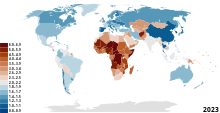
Global fertility rates as of 2020
Sub-replacement fertility is a full fertility rate (TFR) that (if sustained) leads to each new generation beingness less populous than the older, previous 1 in a given area. The United nations Population Division defines sub-replacement fertility as any rate below approximately two.1 children born per woman of childbearing age, but the threshold can be as high every bit 3.4 in some developing countries because of higher mortality rates.[1] Taken globally, the total fertility rate at replacement was ii.33 children per woman in 2003.[1] This can exist "translated" as 2 children per woman to replace the parents, plus a "third of a child" to brand up for the higher probability of males built-in and mortality prior to the end of a person'southward fertile life.[a] In 2020, the average global fertility charge per unit was effectually 2.4 children born per woman.[2]
Replacement-level fertility in terms of the net reproduction rate (NRR) is exactly one, because the NRR takes both bloodshed rates and sex ratios at birth into account.
As of 2010, nearly 48% (three.3 billion people) of the world population lives in nations with sub-replacement fertility.[three] However most of these countries yet accept growing populations due to immigration, population momentum and increase of the life expectancy. This includes near nations of Europe, Canada, Australia, Brazil, Russia, Iran, Tunisia, Communist china, the United States and many others. In 2016, all European Union countries had a sub-replacement fertility rate, ranging from a low of 1.3 in Portugal, Poland, Greece, Spain and Cyprus to a high of ii.0 in French republic.[4] The countries or areas that have the everyman fertility are in developed parts of East and Southeast Asia: Singapore, Hong Kong and South Korea.[four] Only a few countries have had, for the time being, sufficiently sustained sub-replacement fertility (sometimes combined with other population factors like higher emigration than immigration) to accept population decline, such as Japan, Germany, Lithuania, and Ukraine. As of 2020, the full fertility rate varied from 0.84 in Republic of korea[5] to seven.0 in Niger.[6]
Causes [edit]
In that location accept been a number of explanations for the general pass up in fertility rates in much of the world, and the true explanation is almost certainly a combination of dissimilar factors.[ citation needed ]
Higher instruction [edit]

Americans with a bachelor'southward degree or higher past land co-ordinate to the U.Southward. Census Bureau's American Community Survey in 2019.
The fact that more than people are going to colleges and universities, and are working to obtain more than post-graduate degrees there, along with the soaring costs of instruction, take contributed greatly to postponing marriage in many cases, and bearing children at all, or fewer numbers of children. And the fact that the number of women getting higher teaching has increased has contributed to fewer of them getting married younger, if at all. In the US, for example, females make up more than half of all higher students, which is a reversal from a few decades back.[seven]
The human relationship betwixt college pedagogy and childbearing varies by country: for example, in Switzerland past age forty, childlessness amidst women who had completed tertiary didactics is 40%, while in France it is just xv%.[8] In some countries, childlessness has a longer tradition, and was common even before educational levels increased, but in others, such every bit Southern European ones, it is a recent phenomenon; for instance in Spain the childlessness charge per unit for women aged 40–44 in 2011 was 21.60%,[ix] but historically throughout the 20th century it was around 10%.[8] Not all countries show a relationship between low fertility and education: in Czech Republic, of women born in 1961–1965, depression educated women were more likely to exist childless than high educated women.[ten] In the United States in 2019, women with a graduate or professional person caste had the highest birthrate (61 births per ane,000 women), whereas women with less than a high schoolhouse graduate had the lowest birthrate (34 births per one,000 women) amidst all levels of educational attainment of the mother.[11]
Economic fluctuation [edit]
The growth of wealth and homo development are related to sub-replacement fertility, although a sudden drop in living conditions, such equally the great depression, can also lower fertility.[12]
In Eastern European countries, the fall of communism was followed by an economic collapse in many of these countries in the 1990s. Some countries, such as those that experienced violent conflicts in the 1990s, were badly affected. Large numbers of people lost their jobs, and massive unemployment, lack of jobs outside the big cities, and economic dubiety discourages people from having children.[13] For case, in Bosnia-Herzegovina, the total fertility rate in 2016 was only ane.28 children born/woman.[14]
Urbanization [edit]
Some consider the increase of urbanization around the globe a central crusade. In contempo times, residents of urban areas tend to have fewer children than people in rural areas.[15] [16] The demand for actress labour from children on farms does not utilize to urban-dwellers. Cities tend to have college belongings prices, making a large family more expensive, particularly in those societies where each child is at present expected to accept their own bedroom, rather than sharing with siblings as was the case until recently. Rural areas too tend to be more than conservative, with less contraception and ballgame than urban areas.
Reduction of child labour [edit]

Countries which accept a high fertility charge per unit are usually less developed countries, where families rely on children to assistance them, with labour such as agricultural work, tending to livestock, or fifty-fifty paid work. In such countries child labour is quite mutual, with children bringing money at dwelling house, or actively supporting the family through concrete work. By dissimilarity, in high-income nations, child labour is banned, and it is parents who invest very high costs into their children.[17]
Views on the "ideal" family unit [edit]
Although fertility rates are often discussed in terms of state policies (e.g. financial benefits, combining piece of work with family etc.), the deeply entrenched social views on what constitutes an "ideal" family may play a crucial role: if parents do not envision large families in a positive style, it is hard to "convince" them to have many children. In this regard, at that place are major differences betwixt European countries: while fifty.23% of women anile fifteen–39 state that the "ideal" family has 3 or more children in Estonia, and 46.43% say this in Finland; just 11.3% say this in Czech Republic, and 11.39% in Republic of bulgaria.[eighteen]
Contraception [edit]
Changes in contraception are also an important crusade, and ane that has seen dramatic changes in the last few generations. Legalization and widespread credence of contraception in the developed globe is a large factor in decreased fertility levels; nevertheless, for example in a European context where its prevalence has always been very high in the modern era, the fertility rates do not seem to be influenced significantly by availability of contraception.[19]
While contraception can reduce the number of unwanted births and contribute to a smaller ideal family size, contraception does not start fertility reductions nor substantially event their size, with these beingness attributable to other factors.[20]
Assisted reproductive engineering [edit]
The availability of assisted reproductive technology (ART) may foster delay of childbearing, because many couples think that it tin solve any time to come fertility bug.[19] Its upshot on total fertility rate is extremely small but government back up for it is beneficial for families.[19]
Man Development Index [edit]

The Human Evolution Alphabetize (HDI) is a composite statistic of life expectancy, education, and per capita income indicators, which are used to rank countries into four tiers of human being development. A state scores higher HDI when the lifespan is college, the education level is higher, and the Gdp per capita is higher. In that location is a strong inverse correlation betwixt the HDI and the fertility rate of the population: the higher the HDI, the lower the fertility charge per unit. As of 2016, the countries with the highest fertility rate are Burundi, Mali, Somalia, Uganda, Burkina Faso, Zambia, Malawi, Angola, and Afghanistan; while nearly high-income countries have sub-replacement fertility rates.[4] This is part of the fertility-income paradox, as these high fertility countries are very poor, and it may seem counter-intuitive for families at that place to accept so many children. The inverse relationship betwixt income and fertility has been termed a demographic-economic "paradox" by the notion that greater means would enable the product of more offspring as suggested past the influential Thomas Malthus.
Government policies [edit]
Some governments take launched programmes to reduce fertility rates and adjourn population growth. The Prc implemented a one-kid policy for 35 years (from 1979 to 2015); this was relaxed to a ii-child policy in 2016 and relaxed further to a three child policy in 2021.

The Danshan, Sichuan Province Nongchang Village people Public Diplomacy Bulletin Board in September 2005 noted that RMB 25,000 in social compensation fees were owed in 2005, for violation of the one child policy. Thus far 11,500 RMB had been collected, so another 13,500 RMB had to be nerveless.
Although today Singapore has a low fertility rate, and the government encourages parents to take more than children because birth rates have fallen below the replacement charge per unit, in the 1970s the situation was the opposite: the regime wished to slow and contrary the boom in births that started after Earth War Two.
Ability to cull [edit]
The total fertility rate is as well influenced by the ability to choose what type of family to have, if and when to accept children, and the number of children to have - free from coercion, pressure, or interference from the customs, extended family, state or church building. This includes prohibition on practices such equally child marriage, forced marriage or helpmate price. In some cultures for instance, the payment of the helpmate price creates an obligation on the wife to have children, and failure to do so often results in threats and violence.[21] High-income countries have essentially lower fertility rates, and increased childlessness, because people who remain childless or who have small families are less probable to be stigmatized. In many cultures childless women suffer discrimination, stigma, ostracism, and social isolation.[22]
State of war [edit]
It has been shown,[ by whom? ] both historically and in the present day, that societies engaged in a prolonged state of state of war experience a substantial lag in fertility rate.[ co-ordinate to whom? ] The most notable[ opinion ] examples of this phenomenon are accredited[ past whom? ] to the Offset and Second Globe Wars. Modeled past these examples, total war subjects individuals to intense social upheavals and a heavy psychological impact that forcefully prioritizes survival and economic stability over the need to reproduce for the duration of the conflict. Events like these subsequently pave way [23] for an active endeavor to repopulate, such equally the "baby boom" after the Second World War.[24]
Tempo effect [edit]

Total fertility rate (TFR) is afflicted past a phenomenon called the tempo effect, which describes "distortions due to changes in the timing of births."[25] John Bongaarts and Griffith Feeney have suggested that this tempo consequence is driving the decline of measured fertility rate in the developed world.[26] Specifically, the trend in developed countries of having children at later ages can cause the Total fertility rate to be underestimated.[27] For example, as measured past the Homo Fertility Database[28] the United States adjusted total fertility rates have been at replacement levels since 1992.[29]
Type of partnership [edit]
A study of the Usa and multiple countries in Europe came to the consequence that women who go on to cohabit rather than get married subsequently birth take significantly lower probability of having a second kid than married women in all countries except those in Eastern Europe.[30] Another study, on the contrary, came to the result that cohabiting couples in France take equal fertility every bit married ones.[31]
A large survey in the The states came to the result that married women had an boilerplate of 1.ix children, compared to 1.3 among those cohabiting. The corresponding numbers for men were 1.7 and 1.one, respectively. The departure of 0.6 children for both sexes was expected to subtract to between 0.2 and 0.3 over the lifetime when correcting for the confounder that married people have their children earlier in life.[32] In the United States, those who cohabit without marrying had increased fertility when the male earns considerably more than than the female.[33]
Frequency of sex activity [edit]
Another explanation for falling fertility could exist a reduction in the frequency of sexual activity. For example, according to the Nihon Family Planning Association 2016 survey, 47.iii% of the men and 47.1% of the women had not had sex with their spouse in the previous month.[ citation needed ]
High investment per child [edit]
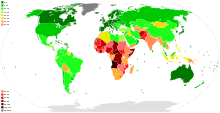
Infant mortality rates, nether age 1, in 2013. Sub-Saharan Africa has the highest baby mortality rate, too every bit the highest TFR.
People are more than likely in modern society to invest strongly in the needs of their children, such equally offer them the best pedagogy, shelter (a room simply for the kid), travel, cultural activities etc. In the by, when child mortality was high, people had more children, but invested less in them. Today, parents unremarkably experience much less doubt about whether the child volition alive to adulthood, and so are more than likely to strongly invest in that child. Merely strongly investing in each child makes information technology more difficult to have large numbers of children—a "quantity vs. quality merchandise-off" consequence.[34]
Gender expectations and norms [edit]
Social norms both inside the family and in society at large determine fertility levels. The quality of couple relations in terms of support given to the woman matters, with studies on fertility in the high-income world showing a U-shaped human relationship between gender equity within the couple and fertility: in countries with very low fertility rates, the probability of a woman to have the second child occurs at the extremes - either very low gender equality or very loftier gender equality.[35] This is as well reflected at a social level: countries that are neither sufficiently patriarchal to coerce women into having large families, nor sufficiently egalitarian to incentivize women to have more children through stiff support (such as subsidized childcare and good support of working mothers), accept very low fertility rates, peculiarly among educated women. Where women are expected to 'choose' between their professional and public life, or having children, the more educated the adult female is, the more than probable she is to choose the one-time. The strong emphasis on the domestic role of women in Germany (different Scandinavia and France) was described as the cause of the very depression fertility in that country.[36] [37] [38]
Historical effects [edit]
The Greek historian Polybius largely blamed the decline of the Hellenistic world on depression fertility rates,[39] writing in his work The Histories that:
In our time all Greece was visited by a dearth of children and generally a decay of population, owing to which the cities were denuded of inhabitants, and a failure of productiveness resulted, though there were no long-continued wars or serious pestilences among us…. For this evil grew upon us apace, and without attracting attention, by our men becoming perverted to a passion for evidence and money and the pleasures of an idle life, and appropriately either not marrying at all, or, if they did marry, refusing to rear the children that were born, or at most 1 or two out of a great number, for the sake of leaving them well off or bringing them up in extravagant luxury.[twoscore]
In a voice communication to Roman nobles, the Emperor Augustus commented on the low birthrates of the Roman elite:[41] [ verification needed ] [ total commendation needed ]
We liberate slaves chiefly for the purpose of making out of them as many citizens as possible. Nosotros give our allies a share in the government that our numbers may increase; yet yous, Romans of the original stock, including Quintii, Valerii, Iulii, are eager that your families and names at one time shall perish with yous.[42]
Upon the establishment of the Roman Empire, Emperor Augustus would introduce legislation to increase the birthrates of the Roman dignity.[43]
Some believe that non just the Great Recession, simply the Great Depression, may have been the result of a decline in birthrates overall. Clarence L. Barber, an economist at the University of Manitoba, pointed out how need for housing in the US, for instance, began to turn down in 1926, due to a decline in 'household formation' (wedlock), due, he believed, to the effects of World War I upon society. In early 1929, US housing demand declined precipitously and the stock market crash followed in October of that same twelvemonth.[44]
Attempts to increment the fertility rate [edit]
One of the nigh forceful attempts to increase the TFR occurred in communist Romania between 1967 and 1990. Communist leader Nicolae Ceaușescu adopted a very aggressive natalist policy that included outlawing abortion and contraception, routine pregnancy tests for women, taxes on childlessness, and legal discrimination against childless people. This menses was depicted in movies and documentaries (such as 4 Months, 3 Weeks and 2 Days, Children of the Decree). These policies increased nascency rates during the menses of policy implementation, just was followed past a decline due to increased illegal abortion.[45] [46] Ceaușescu's policy resulted in over 9,000 women who died due to illegal abortions,[47] large numbers of children put into orphanages by parents who couldn't cope with raising them, street children in the 1990s (when many orphanages were closed and the children ended on the streets), and overcrowding in homes and schools. In improver, Ceaușescu's demographic policies are feared of having very serious furnishings in the time to come, because the generations born under Ceaușescu are large (especially the late 1960s and the 1970s), while those born in the 1990s and 2000s are very small. This is believed to crusade a very serious demographic shock when the erstwhile generations retire, as in that location will exist insufficient immature people in the workforce to support the elderly.[48] [49] [fifty] Autonomously from Romania, a relatively similar policy of restricted reproductive rights during that flow likewise existed in Communist Republic of albania, nether Enver Hoxha (see Ballgame in Albania).
In 2002, the government of Australia gave financial incentives to parents to have more children. This Baby Bonus was introduced explicitly to increase the birth charge per unit. The birth rate in Australia did increment in the years later (see below).
Current effects [edit]
Population aging may pose an economic claiming to governments as the number of retired citizens cartoon public pensions rises in relation to the number of workers. This has been raised equally a political result in France, Germany, and the The states where many people have advocated policy changes to encourage higher birth and clearing rates.
Analysing data for 40 countries, Lee et al. show that typically fertility well higher up replacement and population growth would be well-nigh beneficial for government budgets. Fertility near replacement and population stability, however, would be virtually beneficial for standards of living when the analysis includes the effects of historic period structure on families as well as governments. Fertility moderately below replacement and population decline would maximize standards of living when the cost of providing majuscule for a growing labour force is taken into business relationship.[51]
Forecasts [edit]

United Nation'south population projections by location.
Note the vertical centrality is logarithmic and represents millions of people.
Sub-replacement fertility does not automatically translate into a population decline because of increasing life expectancy and population momentum: recently high fertility rates produce a disproportionately immature population, and younger populations accept higher birth rates. This is why some nations with sub-replacement fertility even so have a growing population, considering a relatively big fraction of their population are still of changeable age. Simply if the fertility trend is sustained (and non compensated by clearing), it results in population ageing and/or population decline. This is already happening and impacts first about of the countries of Europe and East asia.
Current estimates expect the world'south full fertility rate to autumn below replacement levels by 2050,[52] though population momentum continues to increase global population for several generations beyond that. Experts studying this trend limited concerns of the effects of continued human population growth on sustainability and exceeding Globe's carrying capacity and living inside planetary boundaries.
Some governments, fearful of a future pensions crisis, have adult natalist policies to attempt to encourage more women to have children. Measures include increasing tax allowances for working parents, improving kid-care provision, reducing working hours/weekend working in female-dominated professions such every bit healthcare and a stricter enforcement of anti-bigotry measures to prevent professional women'due south promotion prospects being hindered when they take time off work to care for children. Over recent years, the fertility rate has increased to effectually ii.0 in France and ane.9 in United kingdom and some other northern European countries, but the part of population policies in these trends is debated.[53] In Italy, for example, natalist policies may have actually discouraged the Italian population from having more children. This "widespread resistance" was the issue of the Italian government, at i signal,[ when? ] taxing single persons and criminalizing ballgame and even contraception.[54]
European analysts hope, with the assistance of regime incentives and large-scale change towards family-friendly policies, to stall the population decline and opposite it by around 2030, expecting that most of Europe volition accept a slight natural increase by then. C. D. Howe Institute, for example, tries to demonstrate that immigration cannot be used to effectively counter population ageing.[55]
Cases of fertility rate increases in private countries [edit]
U.s.a. [edit]
For 20 years, the total fertility rate in the United States remained relatively stable compared to much of the globe[56] At ane.84 it'south now like to other developed countries.
Other developed countries [edit]
Another adult countries have experienced a temporary or permanent increment in their nascence rate, including French republic, which recorded a TFR of over two.00 in 2008;[57] the United Kingdom where TFR increased from ane.64 in 2000 to i.98 in 2010;[58] Commonwealth of australia, where the nascency charge per unit rose from 1.73 in 2001[59] to one.93 in 2007[threescore] and New Zealand, where the TFR was 2.2 in 2008.[61]
Israel is the but adult country that has never had sub-replacement fertility; a failing Arab and Bedouin fertility rate is countered by religious Jewish groups (by and large Haredim) with higher than boilerplate fertility rates. In addition, the (mostly non-religious)[ citation needed ] aliyah Jews from the former USSR shifted from a 1 child per woman fertility charge per unit to an average fertility rate shut to 2.two children per woman. As of 2008, State of israel'southward Jewish fertility charge per unit is the highest amidst the industrial nations.[62]
See also [edit]
- Demography
- Fertility and intelligence
- List of countries and territories by fertility charge per unit
- Natalistic politics, countering sub-replacement fertility
- Population decline
- Population stabilization
- Economic dynamics
- Income and fertility
- Dependency ratio
- Economic collapse
- Pensions crunch
Notes [edit]
- ^ For example, in the United Kingdom in 2001, 304,635 boys were born as opposed to 289,999 girls, and some of these girls do not survive to the end of their child-bearing years. In future, therefore, the girls born in this yr would have to have more than two children each to replace the full population. For a total caption see Steve Smallwood & Jessica Chamberlain (Spring 2005). "Replacement Fertility, What has information technology been and What does it mean?" (PDF). Population Trends. 119: 16–27.
References [edit]
- ^ a b Espenshade TJ, Guzman JC, Westoff CF (2003). "The surprising global variation in replacement fertility". Population Research and Policy Review. 22 (5/six): 575–583. doi:ten.1023/B:POPU.0000020882.29684.8e. S2CID 10798893. , Introduction and Table one, p. 580
- ^ "Fertility rate, total (births per woman)". The Earth Bank.
- ^ "Figure 8: Population by Total Fertility (millions)" in World Population Prospects, the 2010 Revision. United nations, Department of Economical and Social Affairs, Population Segmentation (2011)
- ^ a b c "Fertility rate, total (births per woman)". The Globe Bank. Globe Bank Group.
- ^ "Korea marks first-e'er turn down in registered population".
- ^ "Niger Full fertility charge per unit - Demographics".
- ^ "NCHS Pressroom - 1997 Fact Sheet - Mothers Education and Birth Rate". world wide web.cdc.gov. 24 May 2019.
- ^ a b "Archived copy" (PDF). Archived from the original (PDF) on xiv December 2015. Retrieved xv February 2017.
{{cite web}}: CS1 maint: archived copy as title (link) - ^ https://www.oecd.org/els/family unit/SF_2-5-Childlessness.pdf[ bare URL PDF ]
- ^ http://demografia.hu/hu/letoltes/publikaciok/EPCposter2016.pdf[ bare URL PDF ]
- ^ "Birth rate past educational attainment of mother U.S. 2019".
- ^ "Archived re-create". Archived from the original on 8 March 2018. Retrieved v February 2017.
{{cite web}}: CS1 maint: archived copy equally title (link) [ total citation needed ] - ^ Pobric, Alma; Robinson, Guy G (2015). "Population ageing and depression fertility: Contempo demographic changes in Bosnia and Herzegovina". Journal of Population Research. 32: 23–43. doi:10.1007/s12546-014-9141-5. S2CID 154600779.
- ^ "Europe :: Bosnia and Herzegovina". The World Factbook. Central Intelligence Agency. 3 November 2021.
- ^ Ueki T (February 1995). "[Analysis of factors related to the recent decline in birth rate in Japan]". [Nihon Koshu Eisei Zasshi] Japanese Periodical of Public Health. 42 (2): 121–8. PMID 7718907.
- ^ Khan HT, Raeside R (February 1997). "Factors affecting the most recent fertility rates in urban-rural Bangladesh". Social Scientific discipline & Medicine. 44 (3): 279–89. doi:10.1016/s0277-9536(96)00076-seven. PMID 9004364.
- ^ https://tad.colman.ac.il/paper-all/9868.pdf[ bare URL PDF ]
- ^ "OECD Family unit Database - OECD".
- ^ a b c ESHRE Capri Workshop Group (2010). "Europe the continent with the lowest fertility". Human Reproduction Update. sixteen (vi): 590–602. doi:10.1093/humupd/dmq023. PMID 20603286.
- ^ Leridon, H., 2006. Demographic furnishings of the introduction of steroid contraception in developed countries. Human Reproduction Update, 12(5), pp.603-616.
- ^ Bawah, Ayaga Agula; Akweongo, Patricia; Simmons, Ruth; Phillips, James F. (1999). "Women'south fears and men'south anxieties: the impact of family planning on gender relations in Northern Ghana". Studies in Family Planning. 30 (one): 54–66. doi:ten.1111/j.1728-4465.1999.00054.x. hdl:2027.42/73927. PMID 10216896. PDF.
- ^ WHO (December 2010). "Mother or nothing: the agony of infertility". Bulletin of the World Health System. 88 (12): 877–953. Archived from the original on 17 March 2014.
- ^ Haupt, A., Kane, T. T., & Haub, C. (2011). PRB's population handbook. Population reference bureau (sixth edition).
- ^ Caldwell, John C. (21 September 2007). Demographic Transition Theory. Springer Science & Business organization Media. ISBN9781402044984.
- ^ Matthijs, Koenraad; Neels, Karel; Timmerman, Christiane; Haers, Jaques (2015). Population Change in Europe, the Eye-Due east and N Africa: Beyond the Demographic Divide. Routledge.
- ^ Bongaarts, J. (2002). "The End of the Fertility Transition in the Developed Earth". Population and Development Review. 28 (3): 419–443. CiteSeerX10.one.1.533.4803. doi:x.1111/j.1728-4457.2002.00419.x.
- ^ Zeitung, Freisinnige. "A Short Explanation of the "Tempo Effect". Medium . Retrieved 27 September 2021.
- ^ "The Human Fertility Database". Retrieved 27 September 2021.
- ^ "United States Summary Indicators". Retrieved 27 September 2021.
- ^ Perelli-Harris B (2014). "How Similar are Cohabiting and Married Parents? 2d Formulation Risks by Matrimony Blazon in the United States and Across Europe". European Journal of Population. thirty (4): 437–464. doi:10.1007/s10680-014-9320-2. PMC4221046. PMID 25395696.
- ^ Balbo N, Billari FC, Mills Chiliad (February 2013). "Fertility in Avant-garde Societies: A Review of Research: La fécondité dans les sociétés avancées: un examen des recherches". European Journal of Population. 29 (1): 1–38. doi:ten.1007/s10680-012-9277-y. PMC3576563. PMID 23440941.
- ^ Gladys Martinez; Kimberly Daniels; Anjani Chandra (2012). "Fertility of Men and Women Aged 15–44 Years in the United States: National Survey of Family Growth, 2006–2010" (PDF). Division of Vital Statistics, National Center for Health Statistics.
- ^ Zhang, Junfu; Song, Xue (December 2007). "Fertility Differences between Married and Cohabiting Couples: A Switching Regression Assay" (PDF). SSRN 1136407.
- ^ Haoming Liu (May 2015). The quantity–quality fertility–education trade-off (PDF) (Study). IZA World of Labor – via wol.iza.org.
- ^ Balbo N, Billari FC, Mills Grand (February 2013). "Fertility in Advanced Societies: A Review of Research". European Journal of Population. 29 (i): 1–38. doi:10.1007/s10680-012-9277-y. PMC3576563. PMID 23440941.
- ^ Kate Connolly (21 September 2012). "Germany's birthrate is the everyman in Europe – and falling fast". The Guardian.
- ^ "Frg passes Nippon to have world's everyman birth rate – study". BBC News. 29 May 2015.
- ^ Luke Harding (26 January 2006). "Germany agonises over 30% childless women". The Guardian.
- ^ Polybius. "Depopulation of Hellenic republic". Histories. Perseus. Vol. 37. Tufts. Retrieved xviii February 2016.
- ^ Polybius (2012). Evelyn S. Shuckburgh (ed.). The Histories of Polybius: Translated from the Text of F. Hultsch. Translated by Evelyn S. Shuckburgh. Cambridge Academy Press. p. 510. ISBN978-1-1080-5079-1 . Retrieved 2 November 2013.
- ^ "UNKNOWN". Project Gutenberg . Retrieved 18 February 2016.
- ^ Dio, Cassius (2004). Dio's Rome, Volume 4. Kessinger Publishing. p. 86. ISBN978-1-4191-1611-7 . Retrieved 3 November 2013.
- ^ "Ancient Rome: Administration of Rome and Italia". Encyclopædia Britannica Online. Encyclopædia Britannica, Inc. Retrieved 17 January 2015.
- ^ Gene Smiley. "Affiliate 7: What Caused the Great Low?" (PDF). The American Economy in the 20th Century. Page 7-1. Archived from the original (PDF) on 9 March 2012. Retrieved 18 December 2011 – via QC econ BBA.
Existent gross housing expenditures on new units tin be separated into two multiplicative components; housing starts and the real boilerplate investment per unit of measurement. 25 Afterwards estimating the determinants of each, Bolch, Fels, and McMahon examined the edifice hypothesis past simulating what would have been the instance in each state of affairs if a "normal" state of affairs had occurred. 26 The result was overbuilding in the number of housing units from 1922 through 1929. They besides plant "overinvestment" per individual housing unit from 1921 to 1928 and conclude that excessive housing starts relative to family germination led to the sharp reject in housing construction at the end of the twenties. In their view the demographic changes in the twenties were the proximate causes of this. In a 1978 written report Clarence Hairdresser was fifty-fifty more emphatic on the importance of demographic changes, suggesting that these were the ultimate explanation of the Not bad Depression. 27 Basing his explanation on a Harrod-Domar growth model, Barber argues that the rapid decline in the population'southward growth rate disturbed that equilibrium, and this rapid autumn in the natural growth rate initiated the depression.
- ^ The ESHRE Capri Workshop Group (2010). "Europe the continent with the everyman fertility". Human Reproduction Update. 16 (6): 590–602. doi:ten.1093/humupd/dmq023. PMID 20603286.
- ^ Horga Thousand, Gerdts C, Potts M (Jan 2013). "The remarkable story of Romanian women's struggle to manage their fertility". The Periodical of Family Planning and Reproductive Health Care. 39 (1): 2–4. doi:10.1136/jfprhc-2012-100498. PMID 23296845.
- ^ Kligman, Gail (1995). "Political Demography: The Banning of Abortion in Ceausescu's Romania". In Ginsburg, Faye D.; Rapp, Rayna (eds.). Conceiving the New Earth Social club: The Global Politics of Reproduction. Berkeley, CA: Academy of California Press. pp. 234–255. AIDSLINE KIE/49442.
- ^ "Bomba de peste 20 de ani: Ce se va intampla cand vor iesi la pensie "decreteii", cei 1,7 milioane de romani intendance sustin economia?".
- ^ "Pensiile "decreţeilor" sunt o bombă cu ceas. Statul le poate plăti 15% din salariu la bătrâneţe".
- ^ "Evenimentul Zilei". Evenimentul Zilei.
- ^ Lee R, Mason A (October 2014). "Is depression fertility actually a problem? Population aging, dependency, and consumption". Scientific discipline. 346 (6206): 229–34. Bibcode:2014Sci...346..229L. doi:10.1126/science.1250542. PMC4545628. PMID 25301626.
- ^ "Population, Health and Human Well-existence — Demographics: Full fertility rate (dynamically generated)". EarthTrends. Earth Resources Institute. Archived from the original on 17 January 2012. Retrieved thirteen June 2010.
- ^ "Suddenly, the former world looks younger". The Economist. 14 June 2007.
- ^ Marchesi M (2012). "Reproducing Italians: contested biopolitics in the age of 'replacement anxiety'". Anthropology & Medicine. 19 (2): 171–88. doi:ten.1080/13648470.2012.675043. PMID 22889426. S2CID 21330049.
- ^ Guillemette, Yvan; Robson, William B.P. (September 2006). No Elixir of Youth: Clearing Cannot Proceed Canada Young (PDF). Backgrounder (Report). C.D. Howe Found. Archived from the original (PDF) on 14 April 2008.
- ^ "Total Fertility Rate of the Us, History plus Forecast". The Frederick South. Pardee Center for International Futures. Academy of Denver. Archived from the original on 22 February 2014. Retrieved 26 April 2012.
- ^ "Tabc3 Tableau complémentaire iii : Taux de fécondité par groupe d'âges" (in French). INSEE.
- ^ "Births and Deaths in England and Wales, 2011 (Provisional)". Office for National Statistics. Retrieved 13 January 2013.
- ^ "Characteristic Article two: Recent Increases in Australia's Fertility". 1301.0 - Year Book Australia, 2008. Australian Bureau of Statistics. 7 February 2008.
- ^ "NOTES". 3301.0 – Births, Australia, 2007. Australian Bureau of Statistics. 28 Oct 2008. Archived from the original on 29 December 2008.
"Births registered, Summary statistics for Australia(a)". 3301.0 – Births, Australia, 2016. Australian Agency of Statistics. 13 December 2017. Archived from the original on 30 December 2017. Retrieved xiii September 2018.(a) Includes Other Territories. Births registered on Norfolk Island from ane July 2016 are included in this publication for the offset time.
- ^ Collins, Simon (nineteen Feb 2009). "Baby boom goes against mothers' advice". The New Zealand Herald . Retrieved fourteen Nov 2011.
- ^ Yoram Ettinger (25 July 2008). "Demographic Optimism, Non Pessimism". The Washington Jewish Week. Archived from the original on 23 February 2014. Retrieved thirteen September 2018 – via The Ettinger Report.
External links [edit]
- Four Surprises in Global Demography Past Nicholas Eberstadt
- Worldwide Total Fertility Rates on the Earth Banking company's website
Source: https://en.wikipedia.org/wiki/Sub-replacement_fertility
0 Response to "what fertility rate is needed to sustain population"
Post a Comment