Read Lost in You Guns and Roses Book 1
Why U2'southward I is the ultimate anthem
(Image credit:
Getty Images
)

U2's anthology Achtung Babe was released 30 years ago this week. Why does its single One continue to take such power, asks Dorian Lynskey.
I
In October 2020, a Parisian schoolteacher named Samuel Paty was murdered by an extremist after showing caricatures of the Prophet Muhammad in a class about liberty of expression. At a televised national memorial service five days later, his coffin was carried into the courtyard of the Sorbonne to the audio of 1 of Paty's favourite songs: U2's 1992 unmarried 1. The adjacent day, the vocal topped France's digital download charts. "That I constitute incredibly powerful," the Border, U2'due south guitarist, tells BBC Civilisation. "Information technology's i of those songs that has this incredible flexibility for different occasions."
More than like this:
- The genre-fluid music ahead of its time
- The most iconic 21st Century song
- The mystery of a 'lost' stone geniusOne's parent album Achtung Baby came out 30 years agone this calendar week. Axl Rose of Guns Northward' Roses in one case said he considered One to exist "one of the greatest songs that has ever been written. I put the song on and just broke downwards crying." In a 2003 special edition of Q magazine, it was voted the best song of all time. It remains a touchstone for the band members, too. "If I was to pick one song which encapsulates everything nearly who and what we are, it would accept to exist One," drummer Larry Mullen Jr once told me. "Every time I hear it or play information technology, information technology connects."
I is then powerful because of, non despite, its insoluble ambiguity. The rolling beauty of the music means that it is both angry and wounding and warm and healing. It is a painful conversation only betwixt who, and about what, is unclear. It has been variously described as a song about a band in crisis, a marriage collapsing, a male parent and son at odds, a country reuniting, another country divided, and a quarrel with God, and maybe information technology is all of those things. One raises the fundamental question of whether a song'due south pregnant is fixed when it is written and recorded, or whether, provided it is flexible enough, information technology can continue to acquire new resonances indefinitely. Who gets to say what a song actually ways?

One has been read as a song virtually a band in crisis, a spousal relationship collapsing, a father and son at odds, a country reuniting, a country divided, and a quarrel with God (Credit: Alamy)
Ane is a song about disunity written against a properties of reunification. Feeling trapped and exhausted by their own success at the close of the 1980s, U2 took a leaf out of David Bowie's book and looked for the future in Berlin, at Hansa Studios. In Bowie's day, the studio had been called "Hansa by the Wall" but now the wall was gone. U2, their producers and engineer (Brian Eno, Daniel Lanois, Overflowing) touched down in Berlin on iii October 1990: the 24-hour interval of German Unity. En route to their accommodation, they got swept upward in the street celebrations equally Federal republic of germany became one country again after 41 years. "The irony of One's title is the ring wasn't very close at the time," Bono tells BBC Culture. "We were building our ain wall correct down the centre of Hansa studios."
Bono and Edge were determined to strip back every signifier of "U2ness" that had accumulated during the 1980s and start over again. Eager to experiment with drum machines, loops and synth pads, they brought to Mullen and bass-player Adam Clayton demos that were little more than grooves. "We were in uncharted territory," Edge tells BBC Culture. "We traditionally had spent quite a lot of time in rehearsal rooms, generating ideas together, only in this case we were using the studio as a writing tool. Adam and Larry were feeling a little left out and resentful. The sessions had got quite tense and the level of common trust was starting to be eroded." In a crumbling studio in a cold and rainy city, the sessions coughed and limped.
'1 but non the same'
One song they got stuck on was Ill Puppy, which eventually became Mysterious Ways. One day, Edge went into the control room to endeavour and resolve this "songwriting roadblock" with a couple of new chord sequences, which Lanois suggested that he combine into the basis for a new vocal. The guitarist returned to the principal room and played them on an acoustic guitar, with Clayton, Mullen and Bono joining in. Information technology was immediately clear that something special was happening – one that singlehandedly justified the trip to Berlin and held U2 together.
"Sometimes you write the song y'all actually need to hear," Bono says. During an improvisation, he tends to sing resonant syllables and occasional words in a gobbledegook the band call "Bongolese", laying downwardly a foundation for the eventual lyrics. "The emotions are already stated in the singing then it'due south like the meaning is there but how to clear information technology?" Edge says. "Even if the exact phrases weren't in that location, they were suggested. It was really a case of getting out of the way of the song."
"I similar to start a vocal halfway through a conversation," Bono says. "Every bit with a lot of dialogue, you very often find yourself talking effectually the subject rather than through it." The first lines came quickly: "Is it getting better or do you feel the aforementioned?/ Is it any easier on you lot at present that you've got someone to blame?" The chorus emerged from an exchange between Bono and the Dalai Lama, who had invited U2 to contribute to a benefit concert called Oneness. Bono politely declined, signing the letter: "Lovely to correspond. 1 but not the same, Bono."
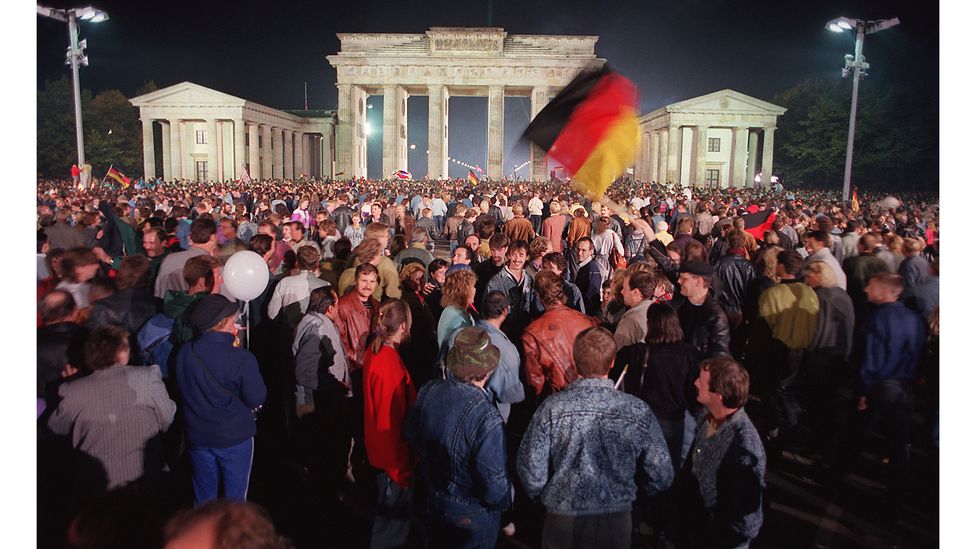
U2 began recording Achtung Babe at Hansa Studios in Berlin in Oct 1990, against the properties of German reunification (Credit: Getty Images)
"The concept of oneness is of class an impossible ask," Bono says. "Maybe the vocal works because it doesn't call for unity. It presents u.s.a. equally being bound to others whether we like information technology or not. 'We get to carry each other' – not 'We got to carry each other'. 'We're one just we're not the same' allows room for all the differences that get through the door."
The conveying, and so, is an observation rather than an didactics. Bono is singing from the country of exhaustion that marks the final phase of an epic argument, when so many accusations have been hurled and grievances voiced that it is impossible to tell whether the participants have cleared the air to try once again or decided that there is no way back. A song so total of disappointment, acrimony, pain and blame cannot exist resolved by a unproblematic weep of "one beloved".
At the time, Edge was in the process of separating from his wife Aislinn while Bono'due south best friend Guggi was too in the death throes of a long relationship. I put to Edge three commonly suggested themes of 1 – divorce, disharmony within the band, and German reunification – and ask if they are all every bit valid.
"Aye, in that location's elements of all of them because they share certain key things," he says. "One of the themes is to see and exist seen: to recognise a person you're really not connecting with and don't fully empathise."
Conversations in Berlin gave Bono something to work with once the band returned to Ireland to continue working on Achtung Babe. "We were riffing on possible scenarios that might fit a song with this intensity," Edge says. "The idea of a father and son estranged was discussed in the room as the lyric was starting to come up out of the fog. Bono adult it into a lyric that independent a lot more than than the conflict and heartbreak that the song opens with, which is why I call up the song has the power it does. There's an development. Information technology doesn't stay in one place. You can almost experience the water ice melting between these two characters equally the song progresses."
The organisation, also, evolved during 1991. 1 was essential to U2 considering information technology was less reliant on rhythm and texture than the rest of Achtung Babe, but Eno disliked it precisely because information technology sounded also pretty and retro. Border switched from acoustic to electric guitar to brand the music every bit fraught and turbulent equally the lyrics. "We could tell in that location was a certain power and gravitas to this slice of music," he says. "Nosotros held onto it even when Brian wasn't enthusiastic." 1 wasn't finished until the very last night of the anthology sessions, 11 months afterward that start improvisation in Berlin. "The lads were literally making the final mix and I said, 'Guys, I've had this amazing idea for a guitar office'," Border remembers. "There was a collective groan in the room. I said, 'Look, here's the deal. 1 take, I promise'. And I did. I played it in i take and they mixed information technology right away. It's the final part that takes the song home."
Fathers and sons
When Achtung Baby was released on 18 November 1991, reviewers agreeably compared 1 to The Rolling Stones, Roy Orbison and Al Dark-green, but its life was just outset. U2 asked the artist, author and activist David Wojnarowicz for permission to use his photo Untitled (Buffalo) on the sleeve of the single release in February 1992, the proceeds of which would get to Aids enquiry. Wojnarowicz had created the piece, which shows a herd of buffalo tumbling over a cliff to their deaths, in 1988, the same twelvemonth he was diagnosed HIV-positive.
Unusually, U2 ended up commissioning three different videos for One, searching expensively for the right message. The get-go, filmed in Berlin in sepia tones by Anton Corbijn, portrayed the band in drag merely Bono felt that it seemed "a little insensitive, stereotyping Aids sufferers every bit gay". Mark Pellington's slow-motion film of buffalo and sunflowers was deemed too arty and minimal for MTV. Phil Joanou'south final version, with Bono smoking pensively in a New York nightclub, was a blank slate that did non insist on ane meaning.
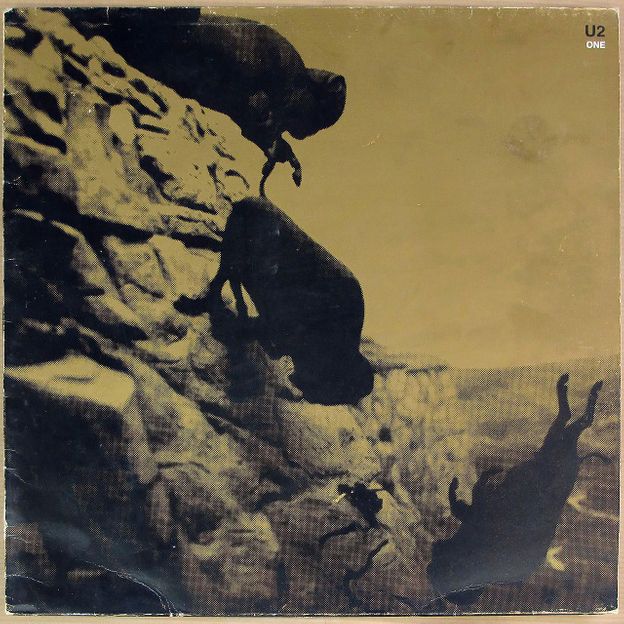
The artwork used for I was Untitled (Buffalo) by creative person, author and activist David Wojnarowicz – the gain went to Aids research (Credit: Island Records / David Wojnarowicz)
The song continued to evolve during the Zoo TV tour, as Bono introduced an extra verse, which came to him out of nowhere ane night in North Carolina in March 1992. Known to fans as Hear U.s. Coming, it asks God a serial of questions, ending with, "Do yous hear us scratching/ Volition you make us crawl?" "It allows a gamble for anger and the focus of that wrath is best kept for religion itself," Bono says. "In the Hebrew Bible, this level of spleen is allowed in the imprecatory psalms: King David shouting at God." He in one case said that this turned One into "sort of a protest vocal against God, from a believer": yet another take on a father and a son.
In January 1993, Michael Stipe and Mike Mills of REM teamed upward with Mullen and Clayton under the name Automatic Infant to play Ane at an MTV Stone the Vote concert to celebrate Bill Clinton's inauguration. Beak Flanagan describes the scene in his fly-on-the-wall book U2 at the Finish of the Globe: "When Stipe sings, 'We're ane but nosotros're non the same, nosotros get to carry each other', he is using the song – however hopelessly – to plead a case and make a promise to this whole country. That'southward a lot of weight for a vocal to acquit! One is a pretty stiff vocal." (Stipe actually changed "get to" to "got to" halfway through just the moment vindicated information technology.)
The song's fluidity is a thread running through Flanagan'southward book: "I seems to have an infinite capacity to open, and U2 shows no inclination to necktie it down." In Deutschland in May 1993, amid a political storm almost immigration, Bono dedicated One to "the immigrants to Germany". In July of that twelvemonth, information technology followed a satellite-linked conversation with a friend of the band in the besieged Bosnian capital of Sarajevo. Bono told journalist Niall Stokes how, in certain contexts, One "suddenly becomes what it is nearly that night." Information technology is a sturdy, inviting vessel for any emotions are circulating in the room, or the land, for there is e'er disharmonize and the hope of resolution. "I take been reduced to a puddle past it myself in the most differentiated environments," Bono says.
Edge's favourite retentivity of performing I is from Madison Square Garden in Oct 2001: U2's start New York concert after nine/11. "After that show, all of the first responders who were present invaded the phase and it became this kind of group therapy session," he recalls. "It was a really humbling matter just to be present as a witness, leave lonely being the goad for it. It was unforgettable."
'An unfinished song'
Bono initially resisted naming the I Campaign, the not-profit he co-founded in 2004 to fight extreme poverty and preventable illness, after this "very bitter song". Nonetheless, it has become a popular selection for U2's benefit concert appearances: for Bosnia in 1995, for Tibet in 1997, for Nelson Mandela in 2003, and at Alive eight in 2005. That same twelvemonth, U2 performed information technology at a fundraiser for victims of Hurricane Katrina, bringing Mary J Blige on phase for the 2d verse. While learning the words ii years earlier for a tribute to Bono, she had begun thinking about 9/11 and its backwash. After, it came to encompass the human ending of Katrina. For her, the lines "Love is the temple, love the higher law/ You ask me to enter and then you make me clamber" represented the cleaved promise of America. "The United States say they intendance about u.s. and stuff like that, and nosotros got to get through and so much," she told journalist Gavin Martin.
"Mary J Blige brought the song places I couldn't possibly have been or understood," Bono says. "I don't know exactly where she went, or the names she put on the places, or the problems she was trying to solve with her interpretation, but I felt them so strongly."
"She made information technology her ain in a way that is kind of amazing," Edge agrees. "Same lyrics, same melody, merely it felt like it was a different song when she sang it."
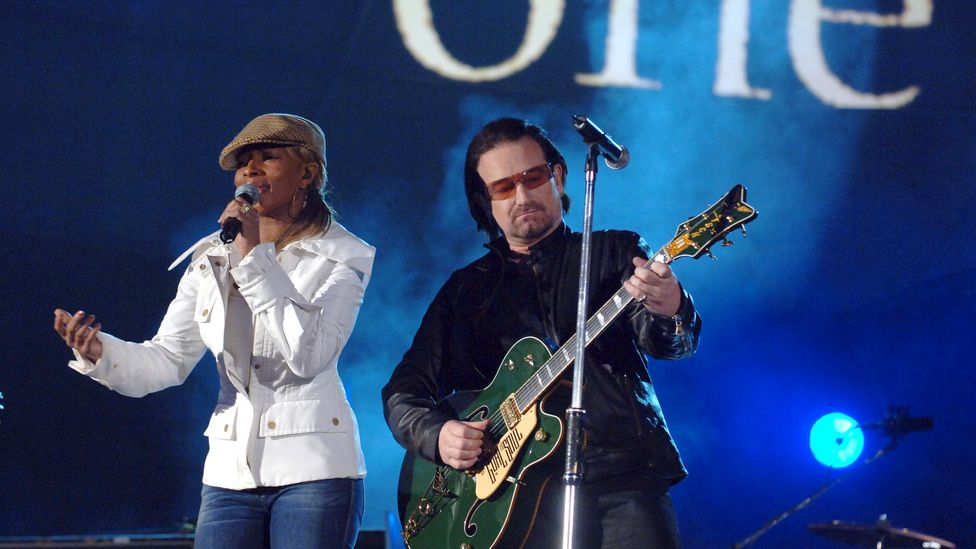
Mary J Blige joined U2 on stage to perform the song at a Hurricane Katrina benefit – she later recorded a version of the song, making it her own (Credit: Getty Images)
"Her dignity cannot be separated from the nobility of all of the people struggling to survive in Louisiana," Danny Alexander, author of Real Love, No Drama: The Music of Mary J Blige, tells BBC Culture. He places One in the soul music tradition of "the song about saving a relationship in problem, whether information technology exist Aretha Franklin'southward Respect or Aaliyah'south We Demand a Resolution. It'southward the gospel answer to the blues vocaliser's solution of moving on. When Bono's ring is in problem, he writes possibly his greatest lyric nearly the value in the contradictions. That arroyo is rooted in black gospel: evidence to the struggle and find redemption in it, if merely in the style the struggle connects you to others."
While Blige took Ane to church, Johnny Cash reimagined it as wintry country music in 2000. Three years before his death, and more than twice as old as Bono was when he recorded it, Greenbacks made Ane's dilemma seem unfixable. The question "Did I disappoint you?" answers itself; "Information technology's too late" is too real. For the state-stone ring Cowboy Junkies, One was the natural conclusion to their 2005 anthology Early 21st Century Dejection. "It was our response to the 'with us or against us' attitude which was far too prevalent after nine/eleven and the invasion of Iraq," says the ring'due south Michael Timmins. "We wanted to record a drove of songs that countered that sentiment, songs that focused on our shared humanity. U2'due south One was a perfect fit."
One, then, tin accommodate not simply the various readings that U2 have best-selling, but Blige'due south indictment of the U.s.a., the Cowboy Junkies' rejection of jingoism, Cash's death's-door accounting, and annihilation that you or I might find inside it. So is there such a thing as a incorrect fashion to hear information technology?
"I'thousand always curious when people play it at their weddings," Edge says, laughing. "It's not celebratory. It's got forgiveness and grace but it's deeply aware of how sometimes things are irreconcilable and all nosotros tin say is we will never make it work. We volition never cantankerous the line and understand each other. It's not similar nosotros're all coming together and it's all going to be fine. It's not going to exist fine. We're non always going to be the same, or necessarily run into things the same style. And yet we become to carry each other. That'southward the tension of information technology."
I noticed that Bono politely dodged my questions about his precise intentions back in 1990-91, as if they might diminish what 1 has since become. He may have written it, merely he is not the arbiter of what it means. "I like to think that the frame of this song is strong enough to hang a lot more stories on than the ones I was not finishing," he says. "One feels similar an unfinished song. The listener finishes information technology."
If you would like to comment on this story or annihilation else y'all have seen on BBC Civilization, head over to our Facebook page or message usa on Twitter .
And if yous liked this story, sign up for the weekly bbc.com features newsletter , called The Essential List. A handpicked pick of stories from BBC Future, Culture, Worklife and Travel, delivered to your inbox every Friday.
Source: https://www.bbc.com/culture/article/20211117-why-u2s-one-is-the-ultimate-anthem
0 Response to "Read Lost in You Guns and Roses Book 1"
Post a Comment